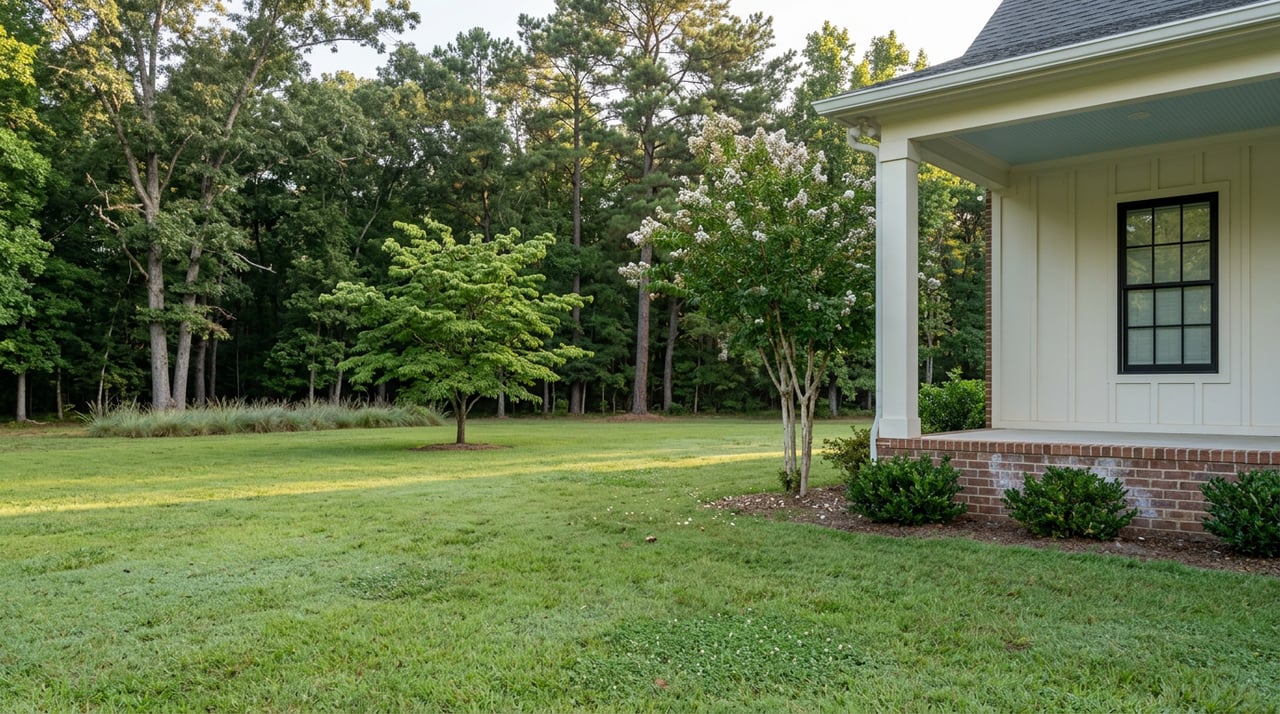
Picture two five-acre parcels a half mile apart on the same stretch of Highway 220. Same road frontage, same rough topography, same county, same tax rate on the books. Yet one carries a property tax bill thousands of dollars lower than the other. A buyer comparing them on a spreadsheet would reasonably assume the cheaper tax bill belongs to the smaller or less desirable lot.
It doesn't. It belongs to the parcel still classified as farmland.
Stokesdale sits at the edge of Guilford County where subdivisions give way to working land, and a meaningful share of what's on the market right now is priced and taxed as if it still is. That distinction matters more to a buyer than almost anything else in the listing, and it rarely shows up until due diligence, if it shows up at all.
The tax bill is doing something you don't expect
North Carolina runs a statewide program called Present-Use Value, and it lets landowners who actively farm, raise timber, or manage horticultural land pay property tax on what that land earns in its current use rather than on what a developer would pay for it. The gap between those two numbers can be large. NC State Extension's overview of the program puts the potential savings at up to 90 percent off the market-value tax bill for qualifying acreage.
That's not a loophole. It's deliberate state policy, meant to keep working farms and forest tracts from being taxed off the land by rising values in growing counties. The forestry side of the program has been on the books since 1974. Guilford County, where Stokesdale sits, is exactly the kind of county the legislature had in mind.
Here's the part that changes how a buyer should read a listing: the tax break travels with the land's classification, not with the seller. Buy the parcel, and unless you keep it in a qualifying agricultural, horticultural, or forestry use, you inherit a bill the low tax line never told you about.
What actually triggers the bill
The program calls it a rollback, and the mechanics are consistent across every source that explains it, from the NC Department of Revenue's own program guide to the tax professionals who help landowners apply for it. The moment a parcel stops qualifying, whether because a new owner builds a house, subdivides the tract, or simply stops farming it, the county doesn't just reassess going forward. It goes back and collects the deferred tax for the current year plus the three years before it, with interest added on top.
That lookback is the number that never appears in a listing description, an MLS sheet, or even a current tax card pulled the week before closing. The tax card shows what the seller has been paying under present-use value. It does not show what the county could collect the day your building permit clears or your survey splits the tract into two buildable lots.
For a buyer evaluating raw land in Stokesdale, this is not a hypothetical corner case. Listing after listing along the Highway 220 and Highway 158 corridor describes acreage as currently agricultural, zoned Residential Agricultural, or previously farmed, sometimes with the future use spelled out plainly, like a thirteen-acre tract near the highway intersection marketed as agricultural today with commercial or industrial potential pending rezoning. That kind of listing language is the buyer's first clue, not a footnote.
Why this shows up so often in Stokesdale specifically
Stokesdale's land market looks different from the tighter, already-subdivided lots common closer to Greensboro. As of August 2026, undeveloped acreage listed in and around town averages roughly $28,600 to $31,000 per acre, a number that reads as an opportunity next to finished suburban lots priced per square foot instead of per acre. Houses paired with a meaningful chunk of land price out differently again, often closer to $250,000 per acre once the structure and improved land are factored together.
Those per-acre numbers are real, but they describe the land as it sits today, tax classification and all. A parcel priced at $30,000 an acre because it currently qualifies for present-use value is not the same asset, dollar for dollar, as a parcel priced at $30,000 an acre with no agricultural classification to lose. The first one has a second price tag attached to it that only appears once you change what the land is for.
This is the piece a simple price-per-acre comparison misses. Two listings can show identical numbers on the surface and carry entirely different total costs of ownership depending on what the buyer plans to do with the dirt.
What a buyer should check before writing an offer
None of this should scare a buyer away from Stokesdale acreage. It should change what gets asked before the offer goes in.
- Ask the listing agent directly whether the parcel is currently enrolled in present-use value, agricultural, horticultural, or forestry classification with Guilford County.
- Pull the current tax card and compare the assessed value to comparable market-value assessments nearby. A wide gap is the tell.
- If the parcel is enrolled, ask the county tax assessor's office for an estimate of the deferred tax liability that would come due on a change of use. This is public information a buyer is entitled to request before closing.
- Build the potential rollback into your total cost of acquisition, not into a surprise bill that shows up with the building permit.
- If you intend to keep part of the tract in agricultural use and build on the rest, understand that North Carolina counties evaluate qualification acreage by acreage. A house on one corner of a ten-acre tract doesn't automatically disqualify the whole parcel, but the split has to be handled correctly with the assessor, not assumed.
A buyer who does this homework before the due diligence period ends holds real leverage. A rollback liability that surfaces during negotiation can become a credit at closing rather than a bill that arrives after the deed is recorded.
The number that actually matters
The thesis here is simple and it's the one most Stokesdale land comparisons get backwards. The lowest tax line on a listing sheet is not evidence of a good deal. In a market where working land sits next to new construction, it's often evidence of a deferred liability waiting for a use change to collect on it. The acreage that looks cheapest per dollar can be the acreage with the largest gap between what it's taxed on today and what it's worth the day you decide to build.
Stokesdale rewards buyers who read past the price per acre and into the classification behind it. That's not a detail for a closing attorney to catch after the fact. It's a number worth knowing before the first offer goes in.
If you're comparing acreage in Stokesdale against tighter lots elsewhere in the Triad, or trying to figure out what a specific parcel's present-use value status actually means for your total cost, Kathy Haines has walked Stokesdale land deals through exactly this kind of due diligence. Schedule a consultation before you write the offer, not after the survey comes back.